 |
|||||||
Navigation Tutorials Others Contact |
Frequenbtly asked questions (FAQ)This page is to answer your questions concerning questions that were asked about Office, the Internet and this site. One calls also this kind of page the "FAQ" for " Frequently Asked Questions " page. It's cut into 6 categories: general information, Internet, Word, PowerPoint, Access and Excel. It's in this order that the subjects are covered during the seminars of the class ADM 1421 at the Université du Québec à Montréal (UQAM). The class title has recently been changed to AOT5100. This page was made to anwser your most common questions about Microsoft Office, the internet and this website. There are six catégories : general information, internet, Word, PowerPoint, Access et Excel. This is the same order as the themes were covered in the ADM1421 course atl'Université de Québec à Montréal (UQAM). You may ask questions to Patrice Roy, the owner of this site. To leave a message to Patrice Roy, contact-me by e-mail. Don't forget to put your name and your e-mail address in your message so that I can contact you. I am going to try to update this page as often as possible as I receive new messages. Before sending me a message, please check this page to see if the answer to your question isn't already there. If the explanation isn'tclear, tell me as soon as possible.
|
||||||

 General
General
Q1: Quels sont les avantages ou les désavantages de l'utilisation d'un certain logiciel?
Contrary to other questions, I will not answer this one. The professors generally ask this question in their first homework. To help you, here is a guide of what is necessary to look at.
Cette question est difficile < répondre
What does it do of better (or worse) than the other software of the same category? By reports(connections) in the other software?
What does it domore (or less) than the other software?
Is it easy to use? To learn? Is the help of the software adequate? And the documentation?
These questions force to dive you into the subject. To read books and magazines on information technology to find comparisons and determine the new options of the software. To try the software by you even and those of it's competitors. It's exactly the intention of the question. It would be cheating to help you, but also the loss of a magnificent opportunity to learn more.
Q2: I don't understand what the professor asks of me to make with this question of the homework.
Once again, the best person to answer this question is your professor. This site was created to give you more help with the software and not with specific questions of your homework.
Q3: Your site contains many pictures of the software. How did you get these pictures?
Any computer can make of the screen shot. It's easy:
 To
press the key PrtScr (Print Screen) located just in the right-hand side of the
F12 key.
To
press the key PrtScr (Print Screen) located just in the right-hand side of the
F12 key.
Open
any software.
From
the Edit menu, select the Paste option.
You can also "paste" the screen shot in an picture editor software to be able to change it to fit your needs. If you want to use the Photoshop software, the procedure is slightly different.
From
the File menu, select the option New.
The size of the picture will be already determined.
You
can then change the name of the picture and press the OK button.
From
the Edit menu, select the Paste option.
To only take the screen shot of a window with the options, press the Alt and PrtScr keys.
Q4: What are the categories of software?
There are many. Too many. Much more than I can name. Furthermore, others categories keep adding themselves with the growth of the possibilities of computers. Here are those that are most easily recognized:
Word processor: Editorial staff and correction of text. Addition of tables, charts besides correction of spelling you will find in almost all the software of this category and much more.
Worksheet: Calculationation of figures, use of mathematical functions headaways(overhangs), creation of the financial and other models (modelling), creation of charts according to the advanced figures.
Data base: Entered by data a structure, query for data in a mass of data, a creation of forms and reports(connections), a programming to automate repetitive tasks.
Graph: Creating a drawings to insert into a word processor or the other software that accept charts.
Presentation: Creating a presentations with tables, charts, drawings and the others to present to a public.
Counting: Answer the accounting(countable) needs of small and big companies.
Electronic publishing: Preparation of documents for professionals: advertisement, articles of newspapers or magazines.
Educationnal: Help to children's learning; young and old.
Conception of Web pages or sites: Allows to create documents or sites completely that will be accessible by the World Wide Web. Some of these most evolved software can even create ready sites for the electronic business.
Statistics: Allow to analyze data or to stand out(go out again) from it of the relevant data.
Project management: Allow to manage a project according to time and the available resources.
Web browser: Software to allow you to"surf the World Wide Web" and the Internet.
Multimedia: Creating a software or interactive presentations having of video and of the sound.
Video assembly: Conversion of "similar" video (on ribbon) in digital size(format) and assembly of several video "clips" for a presentation or to add special effects.
Videoconference: audio and video Communication through dedicated communication rows or by the Internet.
CAD / FAO: Computer-aided design with software such as AutoCAD. Manufacture assisted by computer: Programming of devices and robots of a conveyer belt to create a product.
Reference: Big database on a specific subject: pictures, statistics, finances, census(inventory), goods(articles) of publications...
Simulation: Simulation of process such as conveyer belts or traffic.
And many many others...
Q5: I worked on Windows when the program and the document disappeared. I try to open the document but Windows says me that it's already opened. Why?
This was a mostly a problem before Windows 95 and the taskbar. The program and your document are opened. They are simply hidden. There are two possibilities. The document is hidden last one another document or, more often, the software is hidden by another software or by desktop. To find the document.
 If
the software is visible, select the option Makes windows of the menu.
If
the software is visible, select the option Makes windows of the menu.
look
if the name of your document is available.
If yes,
click the name of the document.
If the document is not available or the software is not visible:
For
Windows 3.x, press the keys CTRL + Esc.
For
Windows 95, press the keys Alt and Tab.
For
Windows 3.x, of the list of opened software, select the check and press the
button Fall over towards.
For
Windows 95, click the good software from the taskbar that is generally located
at the bottom of the screen.
If the software is untraceable in the list of the opened software, it's very possible that you lost your modifications to your document. try however the next time to find it. ask to a technician to use.
Internet
Q1: What is the difference enters the Merlin server and the server Nobel?
Both servers are there to give a service to the students of the University of Quebec in Montreal. You have access to the internet and an address of E-mail and an access to the other services of the internet. The Merlin server is reserved for the students of the first cycle (certificate or high school diploma). The server Nobel is reserved for the students of the second and third cycle (mastery and doctorate) as well as to the professors. Furthermore, the users of Merlin have a menu in the opening of the account to facilitate its use what the other server has not (the last time that I verified).
Q2: Where is "" on the keyboard?
The commercial " a " or the arobas is necessary to write the address of E-mail of a person. For the keyboards of Canadian-French type, you must use the combination of the keys Alt Car and 2. The key Alt Car is the one that is stuck on the right-hand side of spacebar. If you don't find, go to see the page explaining the keyboard to see where is located this key. For the keyboard of American type, use the combination of key Shift key and the key 2.
Q3: How to erase a character when one made(did) a spelling mistake?
use the combination of the keysCTRL and Backspace. " Backspace " is just above the Enter key on the standard keyboard, the long key in the right superior corner.
Q4: Why when I am in the computer lab Netscape refuses to send my message when I press the button with the envelope?
On the internet, it's impossible to send "anonymous" messages. You could enter the necessary data, such as your name and your own address of E-mail, from the options of Netscape. But too many persons forget afterward to delete the option and to verify it. He can so arrive later that a person sends a "uncalled-for" message by using your identity. you're responsible for this data any time.
To avoid this situation, send your message by using the software of E-mail of your account Merlin or Nobel.
Q5: I can use Word, Excel, PowerPoint or Access from my account Merlin?
No. To my knowledge, these software were created for computers. There is no available version for the system of operation Unix used by the Merlin server.
Q6: What is the difference among one Web page and a Web site?
A Web page is a file, as this one, that contains of the text, the pictures and the links on the other pages. A Web site is a group pages on a subject. For example, this site has 85 pages containing more than 950 pictures.
Q7: I don't find any more my messages when I return in the E-mail of Merlin. My messages are erased?
No. They are automatically moved in the mbox file when you close the software of E-mail: that you read the message or not. To see again(revise) your "archived" messages.
From
the main menu. Press the key c.
In
the row " Name of folder: ", write mbox and press the Enter key.
You should now see your former(ancient) messages.
Q8: I am capable of seeing the pictures of my Web page from my floppy disk but not from the public directory. What happens?
There are three possible reasons: you forgot to transfer the files of pictures to the public directory or there is a problem with the names of the files of pictures or you have to transfer the pictures in a size(format) of picture not supported(born) by the World Wide Web.
When you transfer your Web page to the Merlin server by using the procedure written in the pharmacopoeia(codex), you forgot to transfer the pictures. The HTML format does not include the pictures in the document. It reserves simply a place for the picture in the screen. use the procedure in the pharmacopoeia(codex) also to transfer the pictures.
The Merlin server is "more sensitive" to the names of the files than Windows 95 / 98 / NT. It makes(does) the difference between letters in capital letters and those in small letters. So, for the Merlin server, files Image1.gif and picture1. GIF is although different Windows says that they are identical. To solve the problem, the name asked in the Web page and the name of the picture should be identical; including small letters and capital letters. To do it, it will a little be necessary to change code of the Web page.
Open
the Microsoft Word 1997 application.
Open
the Web page the picture of that you don't see.
From
the Edit menu, select the option Codes HTML source.
It's maybe the first time when you see the instructions that compose a Web page. To help you to recognize the codes, there is a page on this site that discusses some conception of Web pages and little of the basic instructions. You noticed that it's about very simple codes. The pictures are not integrated into the file. One space is simply "reserved" for them on the page. It's for that reason that you should transfer the Web page and the pictures to your public directory.
The next part is to demonstrate how to change you the name of the file in the page. To help you to find the codes of pictures among all the instructions of the page, to use the option of query for Word.
From
the Edit menu, select the option Look for.
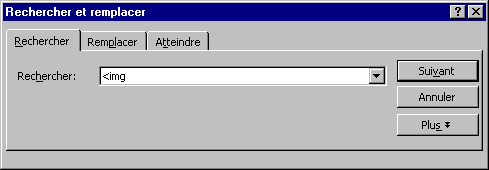
In
the box " Look for: ", write < img.
Press the Next button.
Word will move the cursor in the first command of picture of the Web page. Let's take for example that you find the following code:
< IMG SRC = " Image1.gif "...
The name of the file meets itself between quotation marks.
Change
letters in capital letter in small letter.
Continue
the query for the other codes of pictures in the Web page. bring corrections
when necessities.
When
you ended the corrections, press the button  To
return to the normal publishing(edition) of Word.
To
return to the normal publishing(edition) of Word.
Once correct version, transfer your page in the public directory and look at the result.
A last possibility is that you chose the bad size(format) of picture. There are several sizes(formats) of pictures resulting from several companies. But, on the World Wide Web, there are only three sizes(formats) that are supported(born) at the moment: the size(format) GIF ( Graphic Interchange Format), the size(format) JPEG (pronounced j-peg in English for Joint Photographic Expert Group) and PNG (Portable Network Graphics).
To be certain that your picture is in one of these sizes(formats), verify the extension of the file. Is it .gif.jpg or .png? If yes, everything is well. If there is one the other extension such as .bmp, to .cdr.cmx.tif.wmf or other, it will not be shown on Web. It's necessary that you use a publisher(editor) of pictures such as Photoshop, Paint shop pro or the others to convert your picture in one of the three sizes(formats) mentioned above.
Q9: I try to copy and to paste pictures of the World Wide Web on the Web page. Why it does not work?
It's first necessary to save the pictures to insert them then on the Web page. Copy and to paste will work for this case. To save an picture, it's necessary:
Place
the cursor over the wished picture.
Press the right mouse button.
From the context menu, select the option Save the picture under or Save Image As.
Select the right drive (Hard disk, CD, diskette ...) and the name for the picture.
Press the OK button or Save.
Make sure as well that there are not copyrights on the picture that you want to use. Certain companies or persons protect deeply their logos or their picture. pay attention to their custom(usage).
Word
Q1: I pressed on a button and suddenly I write over the text that I have already wrote. How do I solve this problem?
You activated the " overwrite " option . You will know if the overwrite option is active if you see the letters " OVR " at the bottom of the screen. Press the key "Insert" key to deactivate this function.
Q2: How can I change a block of text from lowercase to uppercase or vice versa?
Select the text you wish to change and press the Shift and F3 keys. By pressing these keys many times, the text will change from lowercase to the first letters in uppercase and then to all the letters in uppercase and back again to lowercase.
Excel
Q1: Because Excel prints blank pages?
Excel prints only the pages that have a contents, even if the contents of a cell are a space. Somewhere on the back page of the printing, there is a cell the only contents of that are a space. It's so impossible to see it.
The best thing to be made is to try to erase the contents of the back page.
Make
a block with all this page. (The empty cells only)
From
the Edit menu, select To erase, Everything.
This should settle(adjust) the situation. To be certain of it, made a preview before printing.
Press
the button  .
.
In the left lower corner of the screen, Excel will inform you about the number of ready pages for the printing. This total number of pages should be lower it(him) to was before. Otherwise, re-try the previous operation with more empty cells. verify then with the outline before printing.
If the problem persists. use the other way of printing.
Make
a block with the cells that you need for the printing.
From
the File menu, select the Print option.
Of
the section Printing, click the radio button Selection.
If you want, you can have an idea of the printing by pressing on the Preview button.
To
begin the printing, press the OK button.
Q2: How to show and to print the Formulas of my working sheets?
From
the Tools menu, select the Options option.
Under
the tab View, select the option Formulas.
Press the OK button.
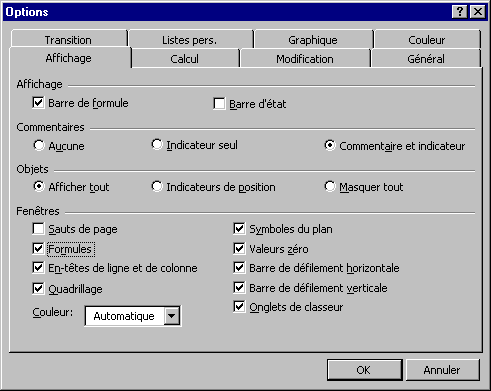
Excel will show you the formula instead of showing yourselves the result of the formula. It will however be necessary to adjust the width of columns. Then you can ask for the printing of Formulas.
To
return to the "normal", deactivate the option Formulas from the options.
Access
Q1: The data what I entered in a table doesn't show in the same order view it later?
It's because you activated the index option to one or more of the fields of the table. Or, you activated a primary key to one of the fields of this table. The primary key needs that the index is activated to work correctly. The records are sorted according to the index; not to the order that the data was entered.
PowerPoint
I'm waiting for your questions!
| You like what you read?
Share it with your friends. |
 This site is hosted by 1&1.com
